Jusheng Zhang

I am a Visiting Researcher at Stanford University, working with Joseph C. Wu and Xuekun Wu on agentic AI for life sciences, and a Student Researcher at Google DeepMind, working with Ming-Hsuan Yang and Liangzhe Yuan on efficient video and vision–language models.

My research connects multi-agent collaboration, reasoning under uncertainty, efficient visual intelligence, and embodied decision-making.

Previously, I worked with teams at Nanyang Technological University, Meta AI, Snap Research, and the HCP Lab of Sun Yat-sen University. Earlier, I worked on risk-control algorithms at Ant Group. More about me ↗

My goal is to help build the next generation of AI agents for scientific discovery.

Agents & LLMs

Expert coordination, learning from failures, and reasoning under uncertainty.

More in this area →
  • Markets of Minds: A 51-Billion-State Economy of Intelligence

    Allocating expert-model assistance across agents by expected benefit and regression risk.

    Jusheng Zhang, Xuekun Wu, Wenhao Wang, Mark Wang, Ming-Hsuan Yang

    arXiv 2026 (Preprint)

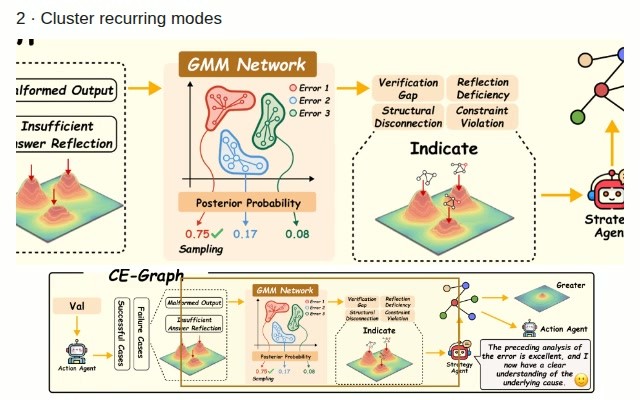
  • Failure-Driven Workflow Refinement

    Turning recurring failure modes into targeted, verified edits to agent workflows.

    Jusheng Zhang, Kaitong Cai, Qinglin Zeng, Ningyuan Liu, Stephen Fan, Jing Yang, Ziliang Chen, Yongsen Zheng, Kwok-Yan Lam, Liang Lin, Keze Wang

    Qinglin Zeng, Ningyuan Liu, and Stephen Fan also contributed to this work; I apologize for inadvertently omitting them from the initial homepage credits, which have now been corrected.

    ICML 2026

    ICML 2026 Spotlight

  • KABB: Knowledge-Aware Bayesian Bandits for Dynamic Expert Coordination

    Matching tasks to expert agents with knowledge-aware Bayesian bandit selection.

    Jusheng Zhang, Zimeng Huang, Yijia Fan, Ningyuan Liu, Mingyan Li, Zhuojie Yang, Jiawei Yao, Jian Wang, Keze Wang

    ICML 2025

  • GAM-Agent: Game-Theoretic and Uncertainty-Aware Collaboration for Complex Visual Reasoning

    Combining specialized agents and a critic through game-theoretic, uncertainty-aware collaboration.

    Jusheng Zhang, Yijia Fan, Wenjun Lin, Ruiqi Chen, Haoyi Jiang, Wenhao Chai, Jian Wang, Keze Wang

    NeurIPS 2025

Vision–Language Models & Video

Coherent reasoning, counterfactual learning, and compact visual representations.

More in this area →
  • Self-Rewarded Multimodal Coherent Reasoning Across Diverse Visual Domains

    Using self-derived coherence and grounding signals to reward multimodal reasoning.

    Jusheng Zhang, Ningyuan Liu, Kaitong Cai, Sidi Liu, Ziliang Chen, Wenhao Wang, Keze Wang

    NeurIPS 2026

    NeurIPS 2026 Spotlight

  • Hybrid Token Compression for Vision-Language Models

    Compressing visual tokens with continuous features and discrete semantic anchors.

    Jusheng Zhang, Xiaoyang Guo, Kaitong Cai, Qinhan Lv, Yijia Fan, Wenhao Chai, Jian Wang, Keze Wang

    CVPR 2026

    CVPR 2026 Highlight

  • CF-VLM: CounterFactual Vision-Language Fine-tuning

    Learning from counterfactual image–text pairs to distinguish minimal visual changes.

    Jusheng Zhang, Kaitong Cai, Yijia Fan, Jian Wang, Keze Wang

    NeurIPS 2025

  • Video Encoders Built on Image Representations

    Building a compact video encoder on image representations with selective temporal context.

    Jusheng Zhang, Wenhao Wang, Longqi Cai, Liangzhe Yuan, Yuxiao Wang, Ming-Hsuan Yang

    arXiv 2026 (Preprint)

  • Vocabulary Scaling Law: Tuning Open-vocabulary Predictors for Their Openness

    Studying vocabulary scaling and selecting class subsets to improve open-vocabulary prediction.

    Z. Chen, Y. Li, L. Fang, Jusheng Zhang*, Y. Zheng, Q. Guan, X. Chen

    CVPR 2026

    CVPR 2026 Highlight

Robotics & Embodied Intelligence

Action prediction, 3D world models, and cooperation between embodied agents.

More in this area →

Further work: RaCoT · AAAI 2026 OralDrDiff · EMNLP 2025 OralFlashVLM · ECCV 2026LLM-CASCoMemTrading Visual Uncertainties

Research note

Can LLMs Debug Robots by Editing Their Weights?

An LLM edited 65 token-embedding rows in a pretrained robot policy. Explore the paired rollouts and replay the complete editing session.

Same instruction. Different outcome.

“activate the cooking appliances heat source”
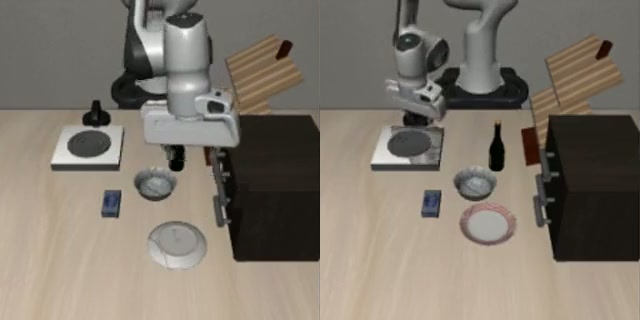
Two views of the same simulated stove task: the original policy moves a plate; the edited policy turns on the stove.
Timed out · 300 stepsSuccess · 78 steps

Selected held-out example · LIBERO simulation
  • Two papers accepted to NeurIPS 2026: Self-Rewarded Reasoning (Spotlight) and E0.
  • Our work at ECCV 2026: FlashVLM (main conference Poster) and ActPhysCause (LoViF Workshop Oral).
  • Joined Stanford University as a Visiting Researcher (terminal-degree requirement waived by the Dean’s Office).
  • Hosted the 1st LoViF Challenge on Efficient VLMs at CVPR 2026; challenge report presented as Workshop Oral.
  • Three papers accepted to ICML 2026: Failure-Driven Workflow Refinement (Spotlight), SOLAR for Offline MARL, and Great Minds Think Alike.
  • Joined Google DeepMind as a student researcher, working with Ming-Hsuan Yang and Liangzhe Yuan.
  • Five papers accepted to CVPR 2026, including two Highlights: HybridToken-VLM and Vocabulary Scaling Law.
  • Two papers accepted to ICLR 2026: Trading Visual Uncertainties and CoMem.

Challenges & Organizing

More details →

Scholarships & Recognition

Full background →

Fellowships & Scholarships

  • Snap Global AI Future Leader Scholarship, 2026 ($30,000)
  • Snap Research Fellowship, 2025 (top 10 globally, $30,000)

Research & Reviewer Recognition

  • Outstanding Reviewer, AAAI, 2026
  • Outstanding Research Contribution Award, HCP Lab, Sun Yat-sen University, 2025
  • Outstanding Reviewer, ICME and ICASSP, 2025

Research figure